Forty freeze-thaw cycles. That’s roughly what a GTA home takes in an average Ontario winter. Most siding guides don’t start there — they start with cost per square foot. The cost question matters, but the material behavior question comes first.
Vinyl siding
Vinyl is the most common siding replacement in GTA homes — $8 to $14 per square foot fully installed, including removal, new house wrap, panels, and trim. A typical semi-detached in North York or the Danforth (roughly 1,200 to 1,500 square feet of cladding) runs $10,000 to $21,000.
Standard vinyl becomes brittle below -20°C, a temperature Toronto hits several times most winters. Impact damage at those temperatures — a stray puck, hailstone, or ladder — can crack panels cleanly. Insulated vinyl has a foam backing molded into the panel. It handles the cold better, reduces contraction, and adds roughly R-3 to R-5, which is meaningful on older GTA homes with no continuous wall insulation.
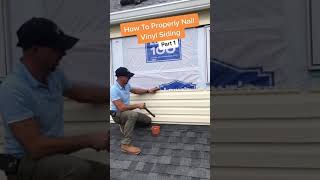
Either way, floating installation is required. Panels fasten at the center of the nail slot, not at the edge, so they can move with temperature changes. Contractors who nail tight are handing you a buckling problem in five years.
Fiber cement (James HardiePlank)
Fiber cement lands mid-range: $12 to $20 per square foot installed in the GTA. For the same 1,500 sq ft of cladding, $18,000 to $30,000.
It doesn’t crack in Ontario winters. It doesn’t absorb moisture the way wood does. It’s non-combustible. For a home near a ravine or in a flood-plain area, those properties matter. It’s dimensionally stable, so it doesn’t expand and contract the way vinyl does.
What most homeowners don’t factor in upfront is paint. Fiber cement arrives pre-primed and needs a paint coat within 180 days of installation, then repainting every eight to ten years. That’s a recurring cost that rarely shows up in the initial quote comparison.
It’s heavier than vinyl — roughly 10 lbs per square foot against vinyl’s 1.5 — which increases installation labor. Fiber cement scores and snaps rather than cutting clean, and the dust requires respirators. Crews without experience with it slow down fast.
Aluminum siding
Aluminum gets dismissed in a lot of GTA renovation conversations because it’s associated with 1960s and 70s construction. That’s worth reconsidering. The original aluminum soffits and fascia on those same homes are often still in serviceable condition fifty years later — frequently in better shape than vinyl replacement siding installed fifteen years ago.
It doesn’t crack. It doesn’t rot. It handles moisture without absorbing it. It’s non-combustible. Installed cost in the GTA: $14 to $22 per square foot. For a 1,500 sq ft home: $21,000 to $33,000 — higher than vinyl, in line with premium fiber cement.
Thin-gauge aluminum dents. This matters on homes with mature trees in the front yard, which is common in older Toronto neighbourhoods, or east of the city in higher-hail areas. Heavier gauge product (0.024" vs. standard 0.019") handles this better; worth specifying in the quote before signing.
The drainage plane most quotes skip
Ontario Building Code requires a drainage plane — a 19mm (3/4") air gap — between the cladding and the house wrap. The gap lets moisture that gets behind the siding drain down and out at the base rather than sitting against the sheathing.
On older GTA homes, this is usually absent in the existing installation. A proper replacement job restores or installs it. Contractors who omit it are meeting a cost target at the expense of long-term performance. Ask for it in writing as a line item in the scope.
Permit triggers
Like-for-like replacement — removing old siding and replacing with a similar product at the same thickness — doesn’t require a building permit in most GTA municipalities, including Toronto.
Adding continuous rigid foam insulation behind the new cladding triggers a building permit in Toronto. The insulation changes the building’s thermal envelope, which puts it under Part 12 of the OBC (energy efficiency). Budget 10 to 20 business days for permit review on top of the project timeline. A lot of homeowners upgrading for energy performance don’t find this out until the contractor mentions it mid-project.
Toronto’s Heritage Register includes over 9,000 properties. If your home is on it — you can check at toronto.ca/heritage — any exterior alteration, including cladding replacement, requires a Heritage Permit before work starts. The timeline is four to twelve weeks depending on whether the proposed change fits the heritage character statement on file.
2026 GTA price ranges
Typical cladding area on a semi-detached or detached GTA home (soffits, fascia, and trim usually quoted separately):
Vinyl: $8–$14/sqft installed ($10K–$21K for 1,500 sqft)
Insulated vinyl: $11–$17/sqft installed ($16.5K–$25.5K)
Fiber cement: $12–$20/sqft installed ($18K–$30K)
Aluminum: $14–$22/sqft installed ($21K–$33K)
Disposal adds $160–$170 per tonne for old material. A full siding strip typically produces half a tonne to three quarters of a tonne of waste — worth asking about before the job starts.
What a complete quote should include
Ask for the material spec (gauge if aluminum, whether insulated if vinyl, product line if fiber cement), house wrap brand and spec, drainage plane detail, window flashing scope (new pan flashing at window bases or existing reused), whether soffits and fascia are in scope or quoted separately, and disposal as a line item. A quote that folds everything into one price makes comparison impossible.
If you’ve been through a GTA siding project — aluminum, vinyl, fiber cement, or something else — what did you find that most contractors don’t mention upfront? Drop it in the comments. Top contributors on exterior renovation topics earn $RENO tier rewards. More on how the earn mechanics work: Welcome to $RENO — Quests, Rewards, Leaderboard