Ontario’s 2025-2026 secondary suite reforms opened Toronto ARUs, garden suites, and laneway builds - but fire, HVAC, and parking still kill most permits.
There’s been enough quiet noise from homeowners about basement apartments, garden suites, and laneway builds this spring that it’s worth putting the 2026 state of play in one place. A lot of the older threads on this forum were written against pre-2025 rules, and the ground has shifted enough in the last year that some of that advice is out of date.
Here’s the short version of what’s actually in force in Toronto right now, April 2026.
Ontario Regulation 462/24 is the backbone
O. Reg. 462/24 came into force November 20, 2024, and it’s the provincial lever that pushed municipalities — Toronto included — to simplify Additional Residential Unit (ARU) rules. Two of the biggest wins for homeowners:
- The old angular-plane requirement is gone for garden and laneway suites. That alone has unblocked a lot of tight lots that used to fail a setback math problem nobody could solve without shrinking the whole build.
- Up to 45% of your lot can now be covered by buildings including ADUs, up from the older tighter coverage caps.
- Minimum 4 m between the primary dwelling and the garden/laneway suite, with some height restrictions attached.
The regulation caps out at three residential units per property (primary home + second unit inside + one garden/laneway). It doesn’t apply if the main building is already a triplex or bigger — that’s a different path.
Toronto By-law 849-2025 layered on top
Adopted by Council on July 24, 2025, this one amends the city-wide Zoning By-law 569-2013 to bring Toronto’s garden suite rules in line with the provincial regulation. If you were quoted numbers on garden suites in 2023 or 2024, have your designer re-check — the permissions are wider now.
What still trips homeowners up
The permit and code side hasn’t gotten looser, and this is where almost every stalled project on our books this spring has gotten stuck:
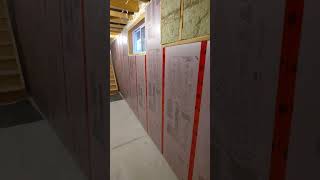
- Fire separation. 45-minute fire-rated assembly between the two dwelling units is non-negotiable. Ceilings, party walls, any shared mechanical penetrations.
- Egress. Proper window or door that meets the code-specified clear opening. A 24x24 basement window you could wriggle out of in 1998 does not meet current rules.
- Ceiling height. Minimum 6’5" under beams/ducts, 7’ for general habitable area. This is the one that kills the most old bungalow basement conversions.
- Interconnected smoke and CO alarms across both units, hardwired.
- Separate entry — strongly preferred, required in some zones.
- Parking — one space per unit remains the working baseline.
The cost side — permits went up in January
City of Toronto interior alteration permit fees moved to $11.09 per square metre effective January 1, 2026, with a minimum of $206.53 and a 4.82% year-over-year increase. For a finished 1,000 sq ft basement that’s roughly $1,000-$1,500 in permit fees alone, before drawings. Budget another $2,000-$5,000 for an architect or BCIN designer — and for secondary suites, you want drawings, not just a sketch.
Processing time on a straightforward interior scope is running 2-4 weeks. Secondary suites with new plumbing/electrical/egress are sitting longer, and Toronto’s permit desk has been a known bottleneck — there’s a good existing thread on that here.
Where this leaves the average homeowner
If you looked at a secondary suite in 2022 or 2023 and walked away because the math didn’t work, it’s worth running it again. A lot of the design constraints that killed projects back then (angular plane, tighter lot coverage, stricter setbacks on laneway builds) have been softened. What hasn’t softened is life safety — and that’s the right place for the rules to hold firm.
A few questions worth throwing out to the forum:
- Anyone gone through a garden suite permit under the new 849-2025 rules yet? How did the review go?
- Homeowners who abandoned a basement suite idea pre-2025 — has your designer re-run the numbers this year?
- Are we seeing any shift in rental demand in Toronto that’s changing the ROI math on secondary suites vs. just finishing the basement for yourself?
Happy to dig into specifics on any of this. If you’re in the GTA and not sure whether your property even qualifies, the first $0 step is pulling your property’s zoning from the city’s AIM tool before you pay anyone for drawings.
A lot of what I’ve learned on this stuff came from 50+ years of my crew pulling non-compliant suites back into code after the fact — which is almost always 3-5x the cost of doing it right the first time. The rules being simpler now is a real win; the code still matters.
More from home.renovation.reviews
- Full-service GTA renovation contractor for basement suites and additions (50+ years): lfbuilders.ca
- Renovation editorial and project guides: blog.lfbuilders.ca
- Community forum: home.renovation.reviews
- Charity: sammsimon.ca — Samm Simon is running 251 KM for cancer research