Spring is the cheapest time of year to fix air leaks in a GTA home, and it is also the time of year you can actually feel them. Cold air sinking through the rim joist into a finished basement, a draft you can read with a paper test at the dryer vent, a furnace that ran most of February to keep up. By June those signals are gone. The math is still there, but you stop noticing.
This is a working homeowner’s guide to whole-house air sealing in the GTA for spring 2026. It covers where leaks actually live in a typical Toronto-area home, how the rim joist and basement headers stack up against the attic, what a blower door test costs and what its number actually means on a gas bill, the DIY-versus-pro line, and where the Home Renovation Savings program currently covers air sealing work. Cost bands are real for spring 2026 quotes in the GTA. The intent is to help you decide what to seal yourself, what to hire out, and which questions to ask the contractor before you sign anything.
Why spring is the right window for air sealing
Two reasons. First, the leaks are still detectable. By mid-April most GTA homes still have a 15 to 25 degree Celsius indoor-outdoor split on a chilly evening, and that pressure differential is what makes air sealing diagnosable. You can feel a leak at the rim joist, or watch a thermal camera light up a recessed light, or run a smoke pencil at a dryer vent and see the draft. By July those tools tell you nothing because the pressure differential collapses.
Second, the trades are not yet stacked into July-and-August renovation backlogs. A blower door test or a rim joist seal in late April or early May lands a quote inside a week. The same call in June often pushes to mid-July. That timing matters less for a 4-hour rim joist job than it does for a full retrofit, but the principle holds across the spring window.
This guide pairs with an attic-specific air sealing piece the forum already has, which covers the attic floor side of the same problem. Most GTA homes need both. A sealed attic over a leaky rim joist gets you maybe a third of the comfort and gas-bill improvement of doing both together.
Where the leaks actually are
Homeowner articles point at the attic almost exclusively. That is half right and half wrong. In a typical Toronto-area detached or semi-detached home built between 1955 and 2005, the attic is the largest single leak surface, but the rim joist and basement headers usually leak more total air per square inch and are easier to fix.
A useful rough split for a typical 1,800 to 2,500 square foot GTA home:
- Attic plane: roughly 35 to 45 percent of total air loss. Pot lights, plumbing stacks, top plates, attic hatch.
- Rim joist and basement headers: 20 to 30 percent. Often nothing but a strip of fiberglass batt jammed into the cavity. Air moves through it like a screen door.
- Exterior penetrations: 15 to 20 percent. Dryer vent, kitchen exhaust, bath fans, hose bibs, gas line entries, electrical panel.
- Windows and exterior doors: 10 to 15 percent. Most of this is the perimeter caulk and weatherstripping, not the unit itself.
- Ducts running through unconditioned space: 5 to 15 percent. Bigger in 1960s-1980s builds with ducts in basements or attics.
If you fix only the attic and call it done, you have addressed roughly 40 percent of the leak. If you also do the rim joist, basement headers, and three or four obvious exterior penetrations, you are at 75 to 85 percent of the achievable seal, and you have done it for under $1,500 in materials and labour combined. Diminishing returns set in past that point unless you are chasing a specific energy-rated target.
Rim joists and basement headers
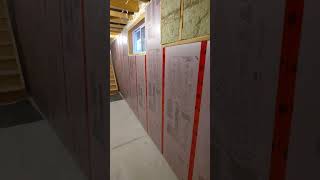
The rim joist is the band of framing that sits on top of the foundation wall and supports the floor joists above. In most GTA homes built before about 2010 it has either fiberglass batt or nothing at all. Air comes up through the foundation, around the sill plate, through the joist cavity, and into the basement ceiling. From there it migrates everywhere.
Two ways to seal it correctly:
The cheap-and-effective path: closed-cell spray foam in a 2-inch lift across each rim joist cavity, after pulling out any old fiberglass. A 1,800 square foot home typically has 30 to 50 cavities to do. Material cost for a homeowner using two-component kits is $400 to $700. Pro labour to install $800 to $1,400 in addition to materials, so all-in $1,200 to $2,100.
The cheaper-and-acceptable path: rigid foam board cut to fit each cavity, sealed around all six edges with a single-component foam can, with attention to wires and pipes that pass through. Material cost $200 to $400 for the same square footage. Pro labour $600 to $1,000. All-in $800 to $1,400. This is slightly less airtight than spray foam but gets you 80 to 85 percent of the result for 60 percent of the cost.
Rim joist sealing is the highest-ROI fix in most GTA homes, full stop. Roughly $200 to $500 in materials and 6 to 8 hours of work covers the highest-leak surface in the building, and the savings show up on the next gas bill, not 18 months from now.
Cross-link: a tighter envelope changes how a whole-house humidifier and a central air conditioning system need to be sized. The tighter the house, the smaller the AC, and the more carefully you need to manage moisture. If you are doing air sealing this spring, plan the moisture and cooling work to follow, not lead.
Exterior penetrations
The five most common exterior penetrations on a GTA home, ranked by typical leak rate:
- Dryer vent. Most builder-grade vents are louvered backdraft dampers that warp open after a few winters. Replace with a magnetic seal damper ($25 to $60 retail, $80 to $150 installed) or a heat-recovery dryer vent ($150 to $300 retail).
- Bath fan venting through soffit. Common in 1990s and 2000s builds. The flapper rarely seals. Same magnetic damper fix, or replace with a roof-cap exhaust if you are already on the roof.
- Range hood vent. Either ducted to outside or recirculating. If ducted, same damper concern. If recirculating, irrelevant for air sealing but bad for indoor air.
- Hose bib penetration. The interior side rarely has any caulk at the foundation block. A bead of polyurethane sealant takes 5 minutes per bib.
- Electrical panel penetration. The conduit entering the panel from outside is often hand-sealed with mortar and not airtight. Polyurethane sealant on the interior side, with care to keep clearance from live service.
These are the kind of items where DIY makes sense. The whole list adds up to maybe $150 to $300 in materials and a Saturday afternoon. A pro doing the same five items would charge $400 to $700.
The blower door test
The blower door test depressurizes a sealed-up house with a calibrated fan and measures the rate at which outside air leaks in. The number it reports is usually expressed as ACH50, which stands for air changes per hour at 50 pascals of pressure differential. Lower is tighter. A few rough benchmarks:
- 8 to 12 ACH50: typical 1950s-1970s GTA home with original construction air sealing. Most of pre-1980 detached.
- 5 to 7 ACH50: typical 1990s-2005 GTA home with builder-grade poly vapour barrier and standard insulation.
- 3 to 4 ACH50: post-2010 builds following Ontario Building Code minimums. Also the level a typical retrofit reaches with a full air-sealing package.
- 1.5 to 2.5 ACH50: high-performance retrofit or current Passive House target. Usually requires mechanical ventilation (HRV) to maintain indoor air quality.
What does this mean on a gas bill? In a GTA climate (about 4,200 heating degree days), going from 7 ACH50 to 3.5 ACH50 typically cuts gas heating by 18 to 25 percent. On a $1,800 annual gas bill that is $325 to $450 a year. The same retrofit also cuts cooling load by 10 to 15 percent on the central AC, worth another $40 to $80 in summer electricity.
Test cost in the GTA for spring 2026: $300 to $450 for a stand-alone test, $400 to $600 if it is paired with a thermal imaging walk-through that identifies specific leak locations. Cheaper if it is bundled into a Home Renovation Savings energy audit, which we cover below.
The test pays for itself in two cases: as a before-and-after measurement on a substantial retrofit, or as a diagnostic on a home where you can feel drafts but cannot tell where they are coming from. If you are doing $400 worth of rim joist sealing and an attic top-up, paying $400 for a blower door test on top is overkill. If you are doing $5,000 worth of envelope work, the test is worth it.
DIY versus hiring out
A useful split:
DIY makes sense for: rim joist with rigid foam and canned foam, exterior penetration sealing (dryer, bath fan, hose bib), attic hatch weatherstripping, basement header batt-and-poly retrofit, electrical box gaskets behind cover plates.
Hire out for: closed-cell spray foam (the kits are tricky and the chemistry is unforgiving), full attic floor sealing (it is hot, dirty, and a 2-day job for two people if you have not done it before), blower door testing, anything inside an exterior wall cavity, and any work near gas appliances or electrical service entries where code-compliance matters.
The split usually breaks down at about $1,000 in materials. If your project list adds up to less than that, DIY makes economic sense. Above that, the labour productivity and the equipment access of a contractor running a foam rig or thermal camera tip the math.
A flag for DIY work near combustion appliances. A house that was previously leaky enough to provide combustion air through random envelope leaks can become starved for combustion air after sealing. If your furnace or water heater is atmospherically vented (the older B-vent style, not high-efficiency direct-vent), this matters. Always have combustion appliances tested for spillage after a meaningful air sealing job. A licensed HVAC tech can do this in 30 minutes for $150 to $250 if you ask specifically for spillage testing.
Home Renovation Savings program
Ontario’s previous air sealing rebates closed in early 2025. The Canada Greener Homes Grant closed for Ontario in early 2024, and the Home Efficiency Rebate Plus program had a final post-retrofit energy assessment deadline of December 1, 2025, with applications closing December 31, 2025. As of spring 2026 the active program is the Home Renovation Savings program, run by Enbridge Gas and Save on Energy with provincial backing.
What matters for air sealing in 2026:
- A pre-retrofit energy audit is required to qualify for any rebate. Cost $400 to $600 retail; some of this may be reimbursed.
- Air sealing as a stand-alone measure has historically been rebated up to $1,300 in past programs. The Home Renovation Savings program rebate amounts are still being finalized at the program level for 2026, so call your registered energy advisor before signing a contract that assumes a specific rebate amount.
- The post-retrofit audit (a second blower door test) confirms the work and triggers payout.
The practical sequence: book the energy audit first. Use the audit as your spec document for the contractor. Have the contractor work to the audit’s specific recommendations. Book the post-retrofit audit when the work is done. Most pro contractors who do this work routinely will guide you through the program mechanics; small handyman operators often will not.
If the program math makes a marginal project economic, do it. If you are doing $400 of rim joist sealing on a Saturday, the audit overhead probably eats the rebate.
Real GTA cost bands, spring 2026
Cost bands are quoted ranges from spring 2026 GTA contractor quotes for a typical 1,800 to 2,500 square foot detached or semi-detached home, materials plus labour, no rebate applied.
DIY supplies, full project (rim joist + 5 exterior penetrations + attic hatch + basement headers): $400 to $700 in materials, plus 12 to 18 hours of your own time across 2 weekends.
Pro rim joist sealing only (rigid foam method): $800 to $1,400.
Pro rim joist sealing only (closed-cell spray foam method): $1,200 to $2,100.
Pro full air sealing package (rim joist + attic plane + exterior penetrations + door and window perimeter): $2,400 to $4,500 mid-tier; $4,500 to $7,500 with closed-cell spray foam throughout and a follow-up blower door test.
Blower door test stand-alone: $300 to $450. With thermal imaging walk-through: $400 to $600.
Pre-retrofit energy audit (qualifying for Home Renovation Savings): $400 to $600 retail, often partially reimbursed. See Ontario energy audit guide for the program-stacking detail.
Add 15 to 25 percent for older Toronto homes with knob-and-tube electrical or pre-1965 construction, where access is harder and the work is slower.
Five questions to ask before signing
- What ACH50 number are you targeting, and how does your scope of work get there? A contractor who cannot answer this is doing handyman caulking, not envelope work.
- Will you spillage-test combustion appliances after the seal? If your water heater or furnace is atmospherically vented, the answer must be yes.
- Is a pre-retrofit and post-retrofit blower door test included in this quote? If not, what would it cost to add?
- What is the rim joist treatment, and which method are you using? Anyone who says “we just stuff some batt in there” is not doing air sealing. Spray foam or sealed rigid foam are the two acceptable answers.
- Are you registered with Enbridge or Save on Energy as a participating contractor for Home Renovation Savings work? If yes, that program’s rebate stacking can offset 30 to 40 percent of the full retrofit cost.
Bottom line by use case
If you are renting or selling within 2 years: skip the audit and the pro retrofit. Do DIY rim joist and exterior penetrations for under $300 in materials. Comfort improves immediately, but you will not amortize a full retrofit before moving.
If you live in a 1990s-2005 home with a $1,400 to $2,000 annual gas bill: rim joist plus attic top-up plus 5 exterior penetrations is the highest-ROI spring 2026 project for you. Budget $1,500 to $3,500 hired out, or $400 to $700 DIY plus your weekend.
If you live in a pre-1980 home with original construction and no prior energy work: book the energy audit first, then plan a full retrofit over 2 to 3 years using Home Renovation Savings to offset cost. Total project across the multi-year plan probably $8,000 to $15,000 with $3,000 to $5,000 in rebates.
If you have a high-efficiency direct-vent furnace and are planning a heat pump conversion in the next 3 years: tighten the envelope first, then size the heat pump on the post-retrofit load. A pre-tightening heat pump quote will be 15 to 25 percent oversized. The size difference is real money.
Companion spring 2026 reading on home.renovation.reviews
- Ontario Attic Air Sealing - What We Found and the Energy Impact. Sister piece, attic-specific scope.
- GTA Whole-House Humidifier Install Spring 2026. Moisture management changes when the envelope tightens.
- GTA Central Air Conditioning Install Spring 2026. Sized differently after a sealing retrofit.
- Ontario Energy Audit 2026: Greener Homes, Enbridge Rebates, and How to Stack Them. The program mechanics.
We have been doing GTA renovation, envelope, and home-systems work for more than fifty years and the questions in this guide are the ones that show up on every air-sealing scope we quote. If you have GTA-specific photos, ACH numbers, or contractor experiences to share, post them in this thread.
Helpful posts on this topic earn $RENO toward the homeowner-and-trades tier ladder. Track the leaderboard at /leaderboard and the public payment record at /t/47016. Linking a Solana wallet on signup is optional but unlocks the airdrop and tier-up rewards.